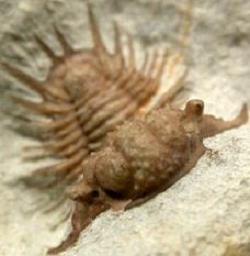
Trilobites are a well-known group of extinct marine animals that had a blend of affinities to the arachnids and crustaceans. They had an easily preserved hard exoskeleton, so these arthropods left an extensive and diverse fossil record throughout marine sediments of the Paleozoic era. The carbonate rocks of Oklahoma's Haragan and Bois d'Arc formations atBlackCatMountainexquisitely preserve more than twenty species of these incredible arthropod fossils.
From their origins in the lower Cambrian, trilobites spread throughout the world and diversified into many thousands of species. Thetrilobites ofBlackCatMountainlived during the middle of the Paleozoic era, represented by the Lochkovian stage of the Lower Devonian epoch. Trilobites found there migrated from other places, or were passing through on their way to someplace else.
Together with many other animals, they inhabited the floor of a shallow subtropical sea that had advanced over the landscape ofNorth America.
The variety of trilobites found atBlackCatMountain span four of the nine established orders of these arthropods, including theLichida,Phacopida,Proetida, andCorynexochida.
Similar trilobites are found in the Lower Devonian rocks ofTennessee,New York,Australia,Morocco, theCzechRepublicand elsewhere.
Photographs of representative trilobites shown in these pages are organized in groups according to their taxonomic hierarchy.
Also shown are photographs of unique or unusual specimens including new Devonian trilobites yet to be described, multiple specimens showing interesting associations, and evidence of trilobite predators.
Why this Website?
This site is dedicated to my many interests in the trilobites found at BlackCatMountain.
These interests include their anatomy and morphology, reproduction and growth, origins and ancestral lineages, migratory patterns and predator-prey relationships, among others.
In addition to the diverse species of trilobites found there, I have also been investigating the features and environmental interpretations of the rocks enclosing these fossils, their geologic history and age, and methods of finding, extracting and preserving the trilobites.
Research on or related to trilobites is continually emerging and I will report on and describe this new work on this website regularly.
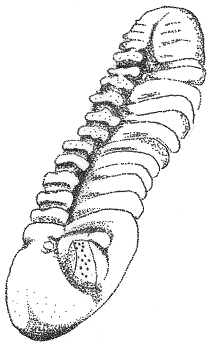
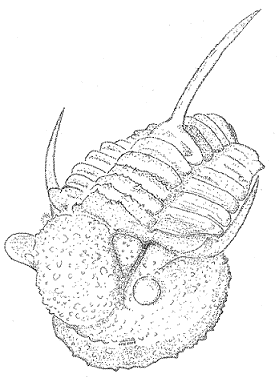
I frequently acquire photographs of these trilobites from others or take them myself and will update this website as I obtain these. I find that drawing trilobites compels me to pay attention to their details, and this helps me follow their technical descriptions in the literature. Some of my drawings illustrate this website. Two are on this page.
If you have questions or comments about the site, do not hesitate to contact me.
A page is available at the end of the site for you to send me messages. I welcome these.
Need further information?
For those who want to know more, my bookTrilobites of Black Cat Mountain, is a layman's handbook and descriptive compendium ofOklahoma trilobites from the Devonian Period, and includes descriptions of other fossils.
The book includes descriptions and explanations of the most current scientific research on these trilobites, and is illustrated with over fifty drawings, charts, maps and photographic plates. Care was taken to place these illustrations close to their discussion within the text so the reader can easily find them.
It is available in hardback, softcover, e-book and Kindle to provide formats and prices to suit a range of needs. Further information is provided in theBook Detailspage of this site. If you would like to order a copy, go to theOrder a Copy page. Trilobites ofBlackCatMountainis also available through on-line vendors such as Amazon, Barnes & Noble and Books-a-Million.
Alternatively, check theRelated WebsitesandGood Bookspages of this site for a wide range of interesting and useful background information on trilobites.
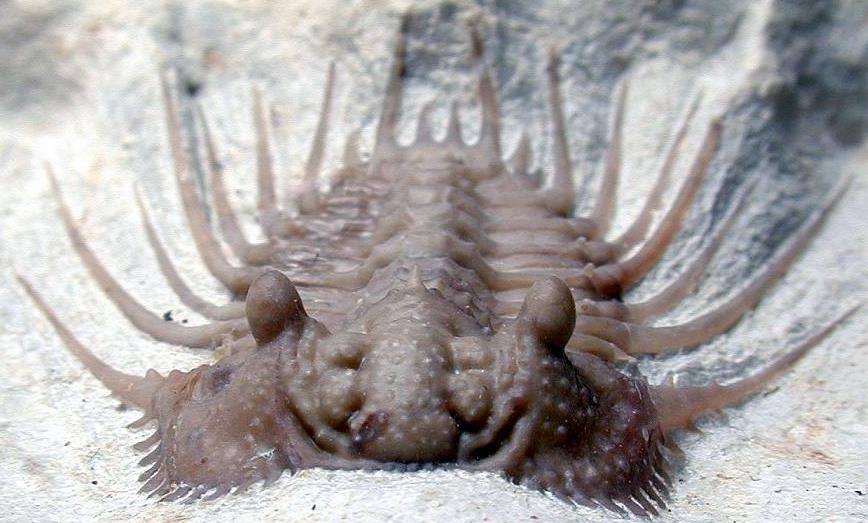
Kettneraspis williamsi, excavated and prepared by Bob Carroll, photograph by G.P.H.